Before cultivation
Wild barley grew across Southwest Asia and adjoining regions. Gathering wild stands is evidence of use, not by itself proof of cultivation or domestication.
Heritage profile · 10Fertile Crescent & Southwest Asia
Hordeum vulgare · cultivated barley
The grain at a glance
“An early cultivated cereal shaped again and again for dry fields, cool seasons, mountain valleys, breads, porridges, and fermentation.”
Origin & landscape
Barley was among the earliest cereals cultivated in Southwest Asia. Archaeological evidence places its long domestication within the Fertile Crescent, while genetic studies show that cultivated barley draws ancestry from multiple wild populations and that its eastern history is complex.
No single date or dot on a map explains the crop. Gathering, cultivation, selection for non-brittle ears, and the development of locally adapted forms happened across generations. Hulled and naked barley, and two-row and six-row types, also carry distinct histories.
Language atlas
Barley vocabularies may distinguish crop, grain, hulless form, malt, flour, porridge, and drink. Translation should preserve those differences rather than collapse them into one universal barley tradition.
The English name covers hulled and naked forms, two-row and six-row ears, landraces, modern varieties, and food, feed, and malting barleys.
Arabic names belong to many regional farming and food traditions across Southwest Asia and North Africa; pronunciation and preparation vary by place.
Across northern South Asia, jau names barley used in flours, porridges, drinks, ritual settings, and mixed farming systems.
Tibetan and Chinese terms are associated with hulless highland barley, central to foods such as tsampa and to farming at high elevation.
Japanese mugi can refer broadly to barley and other wheat-family grains; compound words and dish names provide the needed precision.
Working chronology
Wild barley grew across Southwest Asia and adjoining regions. Gathering wild stands is evidence of use, not by itself proof of cultivation or domestication.
Barley became part of early cultivation systems in the Fertile Crescent. Non-brittle ears, grain form, and site context help researchers trace domestication over time.
Farmers carried and reshaped barley west into North Africa and Europe and east across Central and South Asia. Movement involved repeated selection, exchange, and local adaptation.
By roughly 3,600 years ago, wheat and barley supported more permanent settlement in parts of the Tibetan Plateau, where hulless barley developed enduring significance.
Material witness
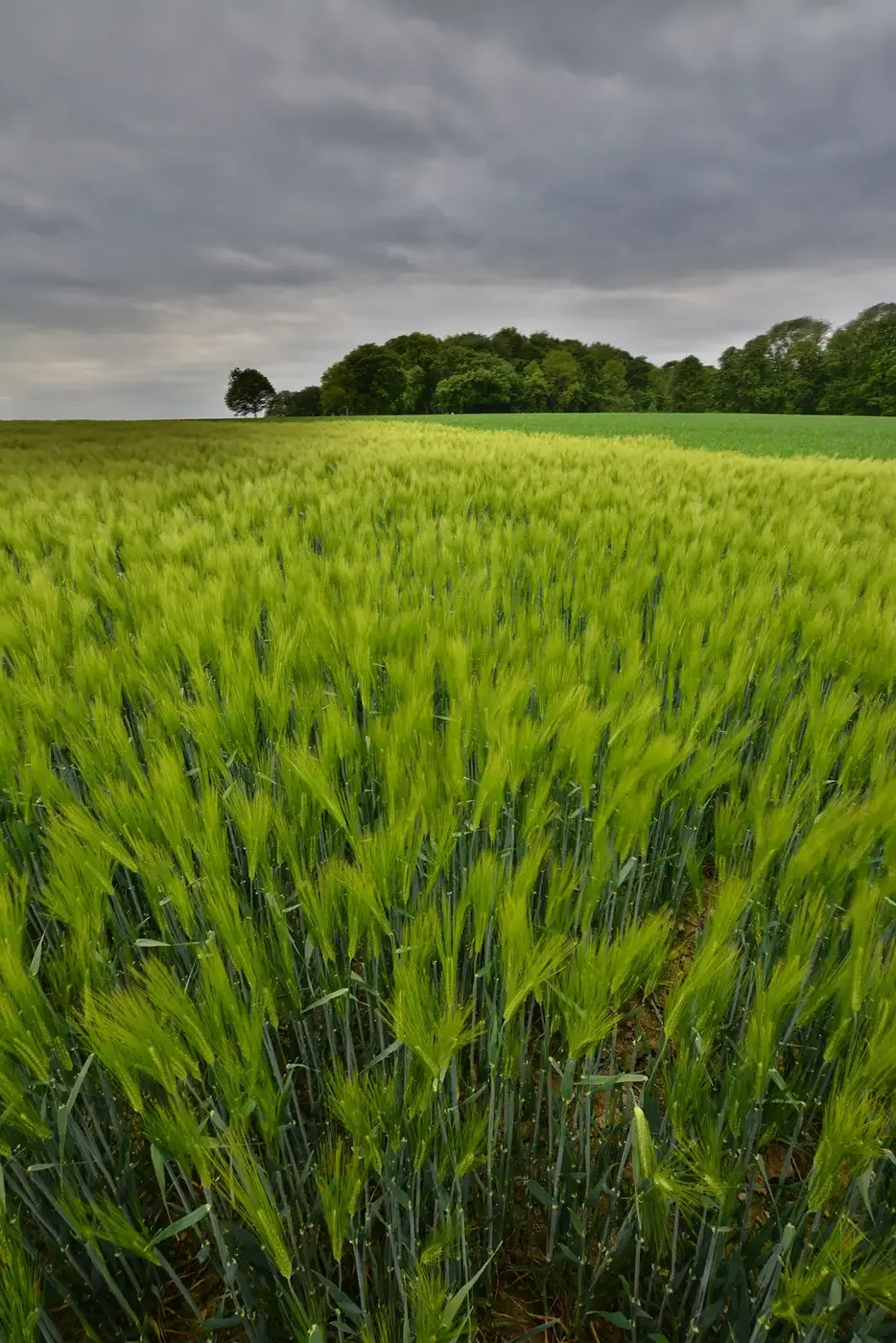
A close field study documents the awned ear and ripening stand; it complements, rather than replaces, the profile's many regional histories.
Research trail
Last editorial review · August 2026 Read the sourcing method →
.jpg)