Before cultivation
Wild Fagopyrum relatives diversified across Asian mountain landscapes; identifying the exact ancestor and domestication setting remains an active field of research.
Heritage profile · 07Temperate Asia
Fagopyrum esculentum · common buckwheat
The seed at a glance
“Not wheat, not a cereal grass—yet carried through flour, noodles, griddles, and bowls across Eurasia.”
Origin & landscape
Common buckwheat is an annual pseudocereal in the knotweed family, not a wheat or cereal grass. Kew places its native range from eastern Tibet into Sichuan and Yunnan, while archaeological and genetic studies continue to debate where cultivation first became domestication.
“Buckwheat” also includes Tartary buckwheat, Fagopyrum tataricum, a related cultivated species with its own traits, tastes, histories, and communities of knowledge. This profile centers common buckwheat and names the distinction wherever evidence or food practice depends on it.
Language atlas
Names can refer to a plant, a seed, flour, a dish, or several cultivated species. DivineGrains records them as pathways into specific languages and communities—not interchangeable labels.
An English name referring to the angular, beech-like seed; botanically it is not wheat.
A broad Chinese name for buckwheat; specific crops, varieties, and foods need more precise local naming.
In Japanese, a name associated with buckwheat and especially its flour noodles, while recipes and proportions vary.
The Korean name carried through noodles, pancakes, jellies, and regionally specific preparations.
A name used across parts of South Asia, including Himalayan food traditions and fasting foods.
Working chronology
Wild Fagopyrum relatives diversified across Asian mountain landscapes; identifying the exact ancestor and domestication setting remains an active field of research.
Archaeobotanical, pollen, linguistic, and genetic evidence point toward an Asian domestication history, but dates and routes should be treated as models rather than a single settled event.
Buckwheat moved through connected uplands, farming systems, and trade networks into Central Asia, the Himalayas, Europe, Korea, and Japan.
Farmers, millers, cooks, and seed keepers continue to maintain common and Tartary buckwheats in distinct local landscapes and food traditions.
Living foodways
Buckwheat’s triangular achenes can be hulled into groats or milled into flour. The result becomes distinct foods through water, heat, fermentation, blending, tools, and practiced hands.
Japanese soba, Korean memil-guksu, and other noodle traditions use buckwheat in different proportions, textures, broths, seasons, and social settings.
Batters become regionally specific pancakes and flat preparations, from Korean memil-jeon to Himalayan and European forms.
Hulled seeds are toasted, simmered, or ground into porridges and dumpling-like staples across Central and Eastern Europe and Asia.
Material witness
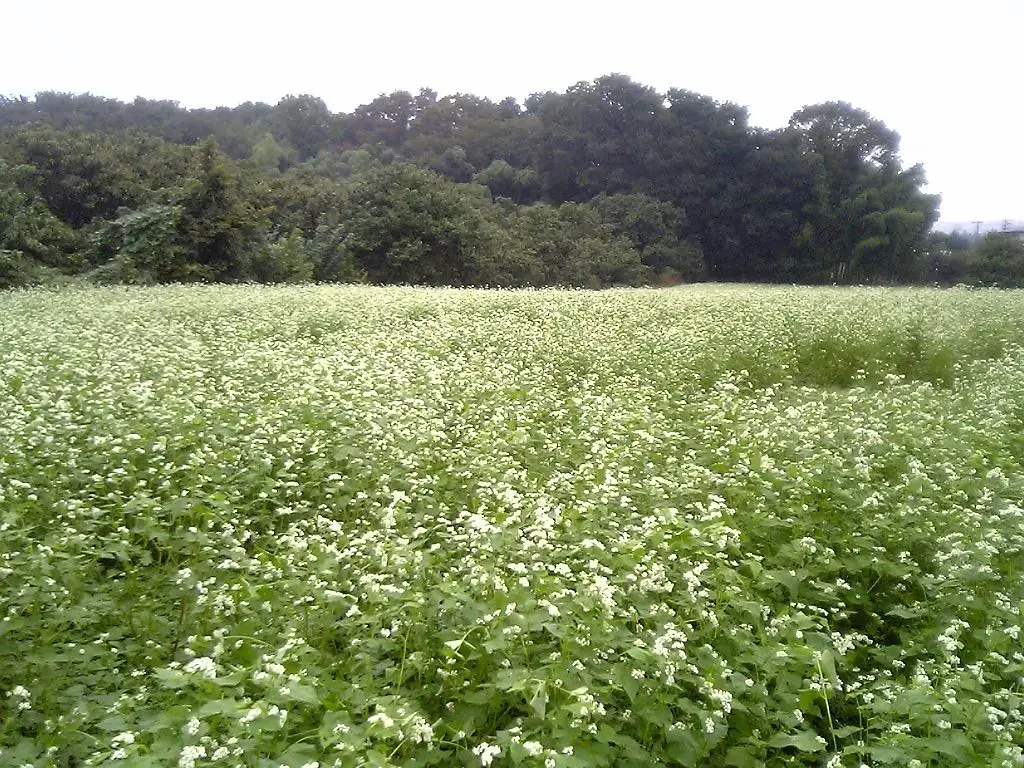
A flowering field in Japan documents one living buckwheat landscape while the profile keeps Himalayan, Chinese, Korean, and other traditions distinct.
Nutrition & evidence
Buckwheat seed supplies starch, protein, fibre, minerals, and varied plant compounds. Composition changes with species, cultivar, growing conditions, hulling, milling, storage, cooking, and serving size. Pure buckwheat is naturally gluten-free, but prepared foods may include wheat or encounter cross-contact.
Research trail
Last editorial review · August 2026 Read the sourcing method →
Continue exploring
